

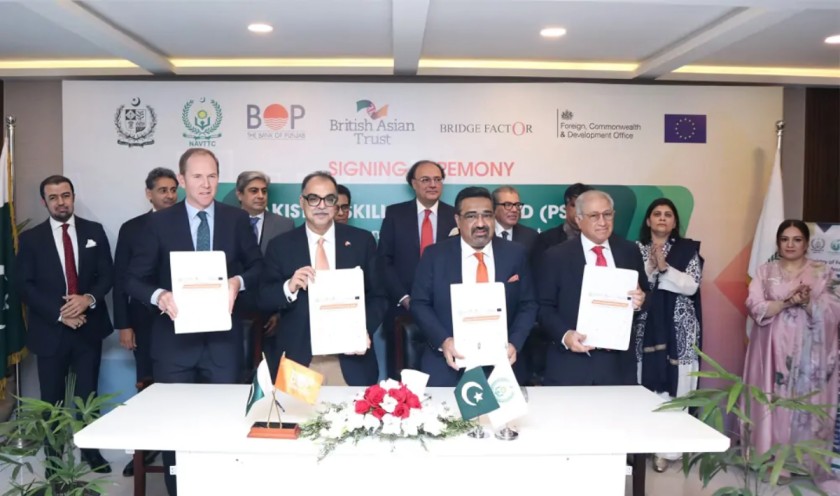
Islamabad: Pakistan marked a major milestone on Tuesday with the launch of its first-ever private-capital-funded Pakistan Skills Impact Bond (PSIB), backed by a Rs1 billion guarantee from the Ministry of Finance, aimed at transforming the country’s approach to technical skills development.
The inaugural Rs1 billion pilot tranche forms part of a three-year Skills Impact Bond programme designed to fund a scalable Technical Skills Development Programme. Unlike traditional public spending models, the PSIB links financing to measurable outcomes, including certification, job placement, and a minimum six-month employment retention for trained participants.
The initiative represents a structural shift from input-based public expenditure to outcome-driven, private-sector-enabled social investment, positioning skills development as a results-oriented economic intervention rather than a welfare expense.
Under the evolving model, future tranches are expected to partially link repayments to a nominal share of trainee salaries, creating a sustainable financing mechanism while enabling Pakistan to better monetise its demographic dividend—both domestically and through the export of certified talent.
The launch ceremony, which included the signing of Investor and Issuer Agreements, was attended by senior government officials, development partners, private sector leaders, and representatives of international organisations.
Addressing the event, Federal Minister for Finance and Revenue Senator Muhammad Aurangzeb described the launch as a “transformational moment” for Pakistan’s human capital strategy and broader economic reform agenda.
“This is an important moment focused on education and training,” he said, stressing that Pakistan’s demographic dividend can only be realised through large-scale upskilling and reskilling of youth.
Highlighting the central role of the National Vocational and Technical Training Commission (NAVTTC), the minister pointed to the global shift toward high-value digital skills—such as blockchain—and noted Pakistan’s growing potential, with its youth forming the world’s third-largest freelancer community.
Senator Aurangzeb said the PSIB reflects a deliberate government-led shift away from traditional budget-based social spending toward evidence-based, accountable, and outcome-oriented financing. He recalled that the Prime Minister had tasked him with chairing a multi-stakeholder Committee on Social Impact Financing, which led to the development of Pakistan’s first Social Impact Financing Framework.
The framework identifies six national priority pillars, with education and human capital at the forefront, followed by gender equality, health and well-being, population stabilisation, climate resilience, and poverty and migration.
Emphasising gender inclusion, the minister welcomed recommendations led by the British Asian Trust to ensure that 40% of PSIB trainees are women, acknowledging women’s critical role in shaping Pakistan’s long-term economic growth.
He described the Ministry of Finance’s Rs1 billion guarantee as catalytic, aimed at crowding in private capital and establishing market credibility for the new structure. He clarified that the guarantee is non-structural and strictly a proof of concept, with a clear roadmap to gradually reduce sovereign support and attract institutional and capital market investors.
“Ultimately, the goal is a self-sustaining model without government balance-sheet exposure,” he said, adding that structured public-private partnerships are essential for achieving scale and credibility in human capital development.
Earlier, Muhammad Amir Jan, Executive Director of NAVTTC, termed the PSIB a defining moment in Pakistan’s skills journey, highlighting NAVTTC’s transition toward a demand-driven, outcome-based skills ecosystem. He outlined reforms in governance, financial transparency, provincial coordination, and industry linkages, repositioning skills training as a strategic investment in national human capital.
Federal Minister for Education and Professional Training Khalid Maqbool Siddiqui also addressed the ceremony, calling the initiative a significant step toward a “better Pakistan and a better future.” He stressed the need for commitment, coordination, and strategic action, and thanked development partners—particularly FCDO and the British Asian Trust—for their continued support.
The ceremony was further addressed by Zafar Masud, President, Bank of Punjab, who provided a strategic overview of the PSIB and its role in Pakistan’s emerging social impact financing landscape. Asif Rangoonwala, Vice Chairperson, British Asian Trust, outlined the Trust’s role as Programme Manager of the PSIB, while Matt Cannell, British Deputy High Commissioner to Pakistan, shared insights on FCDO’s partnership and long-term commitment to Pakistan’s skills and employment agenda.
Gulmina Bilal Ahmad, Chairperson of NAVTTC, acknowledged all partners and reaffirmed NAVTTC’s commitment to delivering measurable, youth-centered results under the Pakistan Skills Impact Bond.
